
Gypsum plaster has quietly become one of the fastest-growing materials in Indian interior construction, and most homeowners and contractors still choose a supplier the same way they’d choose any commodity — by price per bag. That approach works fine until the plaster shrinks unevenly, takes longer to dry than expected, or a second order from the same “brand” behaves nothing like the first. Here’s a more useful way to evaluate gypsum plaster suppliers, backed by where the market actually stands in 2026.
The Current State of India’s Gypsum Plaster Market
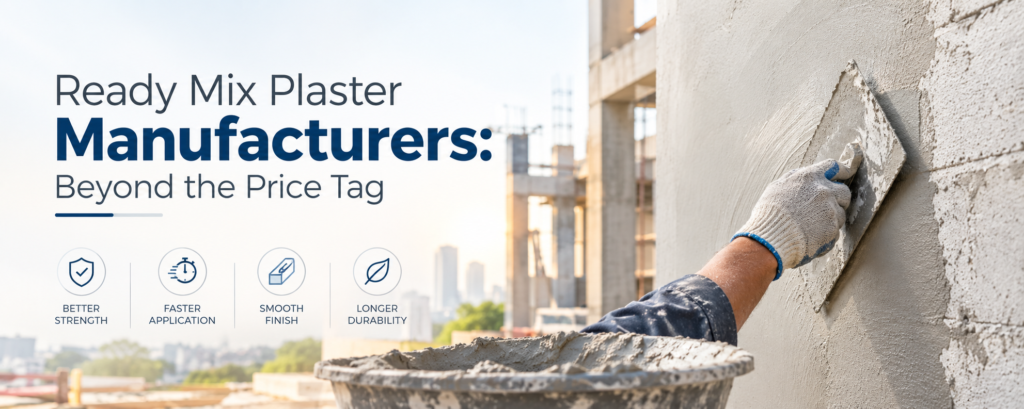
Gypsum plaster has moved from a premium niche product to a mainstream alternative to traditional sand-cement plaster over the past decade, driven by faster application, no water-curing requirement, and a smoother finish with minimal shrinkage cracking. Market research firms differ somewhat on exact valuation depending on methodology, but most agree the segment is growing at a compound annual rate in the range of 6-7%, with urbanization, government housing programs, and rising awareness of gypsum’s advantages over cement plaster cited as the consistent growth drivers across reports.
| Market Indicator | Current Status |
|---|---|
| India gypsum plaster market growth rate | ~6-7% CAGR (varies by research source) |
| Key demand drivers | Urban housing construction, faster project timelines, PMAY and smart city initiatives |
| Regional production hub | Rajasthan, due to significant natural gypsum reserves |
| Recent industry development | Major manufacturers investing in low-carbon and near-net-zero gypsum production facilities |
| Core advantage over cement plaster | No water curing needed, faster wall-readiness, better fire resistance |
Gypsum Plaster vs. Traditional Cement Plaster
| Factor | Gypsum Plaster | Cement Plaster |
|---|---|---|
| Curing requirement | None — ready to paint sooner | Requires water curing over several days |
| Finish quality | Smoother, minimal shrinkage cracks | Coarser, needs additional putty coat typically |
| Fire resistance | Higher | Lower |
| Water resistance | Lower — interior use only | Higher — suited to exteriors |
| Application speed | Faster, single-coat systems common | Slower, multi-coat process standard |
What Actually Separates a Reliable Gypsum Plaster Supplier
- Raw gypsum purity and source control. Suppliers with direct access to gypsum reserves — reflected in Gypsona’s own gypsum mines ownership — generally maintain more consistent purity than those blending traded material from multiple sources.
- Batch-to-batch consistency testing. Setting time and water-retention behaviour should be tested on every production run; a supplier who can’t answer how often they test isn’t one to place a large order with sight unseen.
- Substrate-specific formulation. Gypsum plaster behaves differently on brick versus AAC block surfaces due to porosity differences — ask specifically whether the supplier’s formulation accounts for this rather than offering one universal product.
- Product range depth. Suppliers offering ready-mix gypsum plaster alongside standard bagged plaster and compatible wall putty typically run more integrated manufacturing processes than single-product traders.
- Regional climate suitability. A supplier who can speak to how their formulation performs in your specific climate zone — dry heat versus coastal humidity — understands the practical constraint better than one offering a single nationwide product.
Common Mistakes Buyers Make
The most frequent issue is applying gypsum plaster in inherently damp-prone areas — bathrooms, exterior-facing walls, basements — where it was never designed to perform, then blaming the supplier when it deteriorates. The second common mistake is skipping a sample-batch test before a bulk order; setting time and workability differences between suppliers are far more obvious in a small test patch than on a brochure spec sheet.
FAQs
Is gypsum plaster suitable for exterior walls? Generally no — gypsum plaster has lower water resistance than cement plaster and is best suited to interior walls and ceilings; exteriors typically need a cement-based or water-resistant alternative instead.
How do I evaluate whether a gypsum plaster supplier is reliable for a large order? Ask about their raw gypsum sourcing (direct mine access versus third-party trading), request batch consistency test data, and run a small sample application before committing to bulk quantities.
Why is gypsum plaster growing faster than traditional cement plaster in India? Gypsum plaster doesn’t require water curing, sets faster, and gives a smoother finish with less shrinkage cracking — advantages that align well with the tighter project timelines common in current urban construction and government housing programs.