
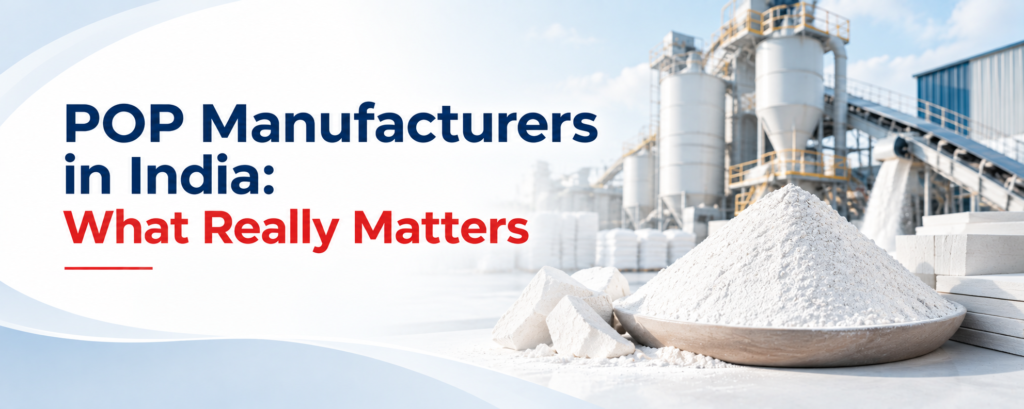
Plaster of Paris looks identical from one 25-kilogram bag to the next — until it’s on the wall. Setting time off by a few minutes, a chalky finish under paint, or a bag that hardens differently from the last batch: these aren’t random quality-control misses. They’re the direct result of which POP manufacturer produced the material and how tightly they control their calcination process.
If you’re sourcing POP for a project or evaluating suppliers, here’s the analysis that actually helps you choose well.
The Scale of India’s POP Industry Right Now
Plaster of Paris production in India runs at a genuinely large scale — industry estimates put national output at roughly 3 lakh tonnes per month, with Rajasthan alone accounting for around 80% of that volume. That concentration isn’t accidental. Rajasthan sits on some of the country’s most significant gypsum deposits, which is why the state has become the manufacturing hub for POP supplying construction markets across northern and western India.
The broader POP market has also been growing steadily — most industry trackers place the segment’s compound annual growth rate in the range of 6% over the past several years, driven by false-ceiling adoption in residential and commercial interiors, orthopedic and medical-grade POP demand, and continued use in decorative moulding and art applications.
| Market Indicator | Current Status |
|---|---|
| National POP production | ~3,00,000 tonnes/month (industry estimate) |
| Rajasthan’s share of production | ~80% of national output |
| Key demand drivers | False ceilings, interior décor, orthopedic casts, construction repair work |
| Typical retail price (25kg bag) | Roughly ₹200–₹430 depending on grade and location |
| Ideal setting time (quality benchmark) | 20–35 minutes |
Why Manufacturer Choice Matters More Than Brand Recognition
A POP manufacturer’s process determines three things a buyer actually experiences on site: setting time consistency, whiteness/finish quality, and how the material behaves under humidity. Under-calcined gypsum sets unpredictably and can leave a soft, chalky surface; over-processed material can set too fast for a mason to work with properly. Neither shows up on a bag label — it only shows up once you’re mixing it.
This is why buyers increasingly look past the price-per-bag comparison and ask harder questions: does the manufacturer control raw gypsum sourcing directly, or trade third-party material? Do they test each batch for setting time and whiteness, or rely on a generic quality claim? A manufacturer that also produces related calcined-gypsum products — like gypsum plaster and ready-mix gypsum plaster — typically runs shared processing infrastructure, which tends to produce more consistent POP batch to batch than a single-product trader.
What to Check Before Placing a Bulk POP Order
- Setting time consistency — request test data or run a small sample batch before committing to a large order; 20–35 minutes is the widely accepted quality benchmark.
- Source of raw gypsum — manufacturers with direct mine access, such as those referenced in Gypsona’s own gypsum mines ownership infrastructure, generally maintain tighter purity control than resellers sourcing from multiple third parties.
- Moisture sensitivity handling — standard POP is not suited to exterior or high-humidity applications; ask specifically whether the manufacturer offers a variant suited to your climate and use case.
- Compatibility with finishing products — POP used under wall putty or paint performs differently depending on formulation; check whether the manufacturer’s wall putty range is designed to work with their own POP base for a consistent finish system.
Common Buyer Mistakes
The most frequent issue isn’t a bad bag — it’s mismatched expectations. Standard POP applied on an exterior wall will fail regardless of how good the manufacturer is, because the product category itself isn’t water-resistant. Similarly, buying purely on lowest price per bag without checking coverage or setting-time consistency often costs more once rework and material wastage are factored in.
FAQs
How can I tell if a POP manufacturer’s product is genuinely high quality? Check setting time consistency (20–35 minutes is standard), run a small test batch before bulk ordering, and ask whether the manufacturer sources gypsum directly or through multiple traders — direct sourcing generally means tighter purity control.
Why does most of India’s POP come from Rajasthan? Rajasthan holds a significant share of India’s gypsum reserves, which has made it the natural manufacturing hub — industry estimates suggest the state accounts for roughly 80% of national POP production.
Is POP suitable for exterior walls? No — standard Plaster of Paris is highly moisture-sensitive and is intended for dry interior ceilings and walls only; exterior applications need a water-resistant plaster or cement-based alternative instead.