
Last Updated: August 29, 2026
Choosing a wall putty company in India by brand recognition alone is how most buyers end up disappointed. The bigger, more useful question is what actually separates a wall putty manufacturer worth ordering from repeatedly versus one that looks the same on a spec sheet but underperforms on-site. This guide walks through exactly that — what quality wall putty requires, how manufacturing standards differ, and where Gypsona India Private Limited fits into that picture.
What Wall Putty Actually Is (Beyond “White Powder Before Paint”)
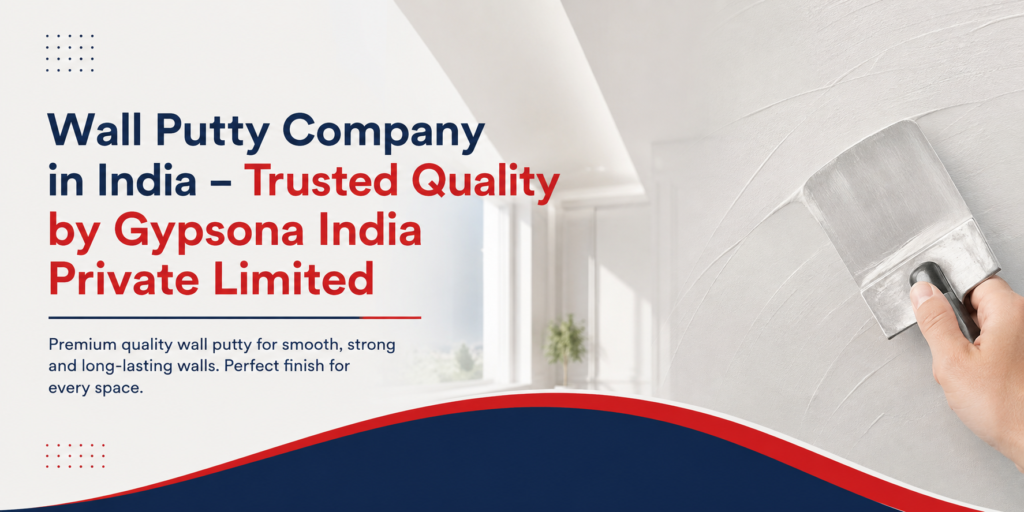
Wall putty is a fine, mineral-based finishing compound — built on gypsum, white cement, or acrylic-polymer chemistry depending on the formulation — applied over plastered or POP-finished surfaces before painting. Its job is narrow but critical: level out microscopic surface irregularities, seal wall porosity, and give paint a uniform, well-bonded surface instead of an inconsistent one.
Skip it, or use a poor-quality version, and the wall still gets painted — it just won’t hold up. Paint applied directly over unfinished plaster absorbs unevenly, shows patchy sheen under direct light, and bonds weaker to the substrate, which is exactly why walls without proper putty are the first to peel, flake, or dull within a year or two.
The three main putty chemistries used in the Indian market behave differently enough that “wall putty” as a category doesn’t tell you much on its own:
| Putty Type | Base Material | Typical Use | Trade-off |
|---|---|---|---|
| Gypsum-based putty | Calcined gypsum | Interior walls, ceilings, POP surfaces | Excellent finish and low shrinkage, but limited water resistance |
| White cement-based putty | White Portland cement + polymers | Exteriors, bathrooms, humid zones | Higher water resistance, but faster setting and more shrinkage-crack risk |
| Acrylic wall putty | Acrylic polymer emulsion | Ready-to-use retail packs, small-area touch-ups | Fastest application, but generally costlier per coverage area than powder-based options |
A wall putty company that only offers one chemistry is implicitly telling you it’s optimized for one climate and one wall type — worth checking before you standardize an entire project’s material order on a single product.
Why Manufacturing Process Matters More Than the Label
Two bags of “gypsum wall putty” can perform very differently on the same wall, and the reason almost always traces back to manufacturing, not marketing.
Raw Material Purity
Gypsum purity directly determines setting time consistency and final surface smoothness. Lower-purity gypsum, often bulked with cheaper filler material to cut cost, tends to set unevenly and produces a coarser final texture that needs extra coats to compensate — which erases whatever price advantage the cheaper bag offered in the first place.
Grinding Fineness
Particle fineness affects both workability and finish quality. Coarser grinding is cheaper to produce but leaves a rougher surface that shows through even multiple coats of premium paint. Finer grinding costs more in processing but is the difference between a “good enough” wall and a genuinely flat, professional finish under raking light — the kind that shows every imperfection if the substrate underneath wasn’t properly prepared.
Batch Consistency
This is the one buyers rarely think to check and the one that causes the most on-site frustration. If a manufacturer’s setting time, water demand, or whiteness varies bag to bag, your mason ends up re-adjusting mix ratios mid-project, which shows up as visible tonal or texture differences between walls finished on different days. Ask any established wall putty company for their batch-to-batch consistency data or quality-control testing frequency — a manufacturer confident in their process will have a direct answer, not a vague reassurance.
How to Actually Evaluate a Wall Putty Company (Not Just a Product)
Most buying decisions focus entirely on the bag — price per kilogram, coverage claims, brand name. That’s backwards. Evaluate the company first, because the company’s process determines whether the product performs the same way on your third order as it did on your first.
- BIS conformity. Gypsum plaster and putty products manufactured in India are expected to align with IS 2547 (Parts 1 and 2) specifications for gypsum building plaster. A company that can speak specifically to which standard their formulation targets is operating differently than one that only offers a generic “premium quality” claim.
- Raw material sourcing. Ask where the gypsum comes from and whether the company has direct mine access or relies entirely on third-party trading. Direct sourcing generally gives a manufacturer more control over purity and supply consistency — both of which affect the product you actually receive.
- In-house testing capability. A company that tests whiteness, setting time, and water retention on every batch — rather than relying solely on a supplier’s certificate — is positioned to catch quality drift before it reaches your site.
- Regional formulation awareness. India’s climate range, from Rajasthan’s dry heat to coastal humidity, means a putty that performs well in one region can underperform in another. A company offering climate-adjusted formulations, rather than one universal product for the whole country, understands the practical constraint better.
- Supply reliability for large orders. For contractors managing multi-phase projects, consistent lead times matter as much as product quality — a supplier that can’t reliably deliver bulk quantities on schedule creates project delays regardless of how good the material itself is.
- Product range depth. A company manufacturing wall putty alongside related products — gypsum plaster, POP, AAC block-compatible plaster — usually has broader in-house process control and quality infrastructure than a company trading a single finished product sourced from elsewhere.
Where Gypsona India Private Limited Fits
Gypsona India Private Limited operates under Garg Brothers Plaster Industries and manufactures across a connected product range — gypsum plaster, Plaster of Paris, wall putty, AAC blocks, fly ash bricks, and agricultural-grade gypsum — rather than a single standalone product line. That matters for the evaluation criteria above: a company producing gypsum-based materials across multiple applications generally maintains shared raw-material sourcing and processing infrastructure, which is one practical reason batch consistency tends to hold up better than it does for single-product traders repackaging third-party material.
The company’s product catalog spans calcined gypsum products (plaster, brick bond, ready-mix plaster), lime products, and agricultural gypsum granules alongside wall putty — indicating the kind of integrated gypsum-processing operation that direct-source manufacturers typically run, as opposed to a purely retail-facing brand.
For buyers specifically evaluating wall putty, the practical questions worth asking any manufacturer — Gypsona included — remain the same ones outlined above: which IS standard the formulation targets, what the tested coverage rate is for your specific wall type, and whether the product line differentiates between interior and exterior-grade use. A company’s own product page should be able to answer all three without vague language.
What Changed in the Wall Putty Market Between 2024 and 2026
A few practical shifts are worth knowing if you’re comparing options against older information:
- Greater buyer awareness of gypsum-vs-cement putty trade-offs. What used to be treated as interchangeable products is now more commonly understood as two distinct chemistries suited to different wall conditions — buyers increasingly ask for climate-specific recommendations rather than accepting a single universal product.
- Rising scrutiny on raw material sourcing. With gypsum supply tightening in some regions, buyers and contractors are asking manufacturers more directly about mine access and sourcing reliability rather than assuming consistent availability.
- Wider adoption of AAC block construction has increased demand for putty formulations specifically compatible with AAC’s higher surface porosity, rather than assuming standard cement-plaster putty performs identically on both substrates.
- More competitive bulk pricing as manufacturing capacity has expanded, making direct-from-manufacturer sourcing increasingly cost-competitive against multi-layered distributor pricing for large projects.
Common Mistakes When Selecting a Wall Putty Supplier
- Choosing purely on price per kilogram without checking coverage rate — a cheaper bag that needs more material per square foot to achieve full coverage can end up costing more overall.
- Assuming one putty type works everywhere — using an interior-grade gypsum putty on an exterior or bathroom wall, where a cement-based or water-resistant formulation would actually hold up.
- Not asking for a sample batch before a bulk order — a small test application reveals setting behaviour, workability, and finish quality far more reliably than a spec sheet.
- Ignoring supply consistency for multi-phase projects — a supplier who’s excellent on a small order but can’t guarantee the same lead time and batch quality at scale creates real project risk.
FAQs
What should I check before choosing a wall putty company in India?
Check whether the company sources its own raw gypsum or trades third-party material, whether they test batch consistency in-house, which IS standard their formulation targets, and whether they offer climate-specific formulations rather than one universal product for the entire country.
Is gypsum-based wall putty better than cement-based putty?
Neither is universally better — gypsum-based putty generally gives a smoother interior finish with lower shrinkage-crack risk, while cement-based putty offers higher water resistance suited to exteriors and consistently humid areas; the right choice depends on where on the building it’s being applied.
How do I know if a wall putty manufacturer’s product is genuinely consistent batch to batch?
Ask directly about their in-house testing process and frequency — a manufacturer that tests whiteness, setting time, and water retention on every batch, rather than relying only on a supplier certificate, is far more likely to deliver consistent results across repeat orders.
Does Gypsona manufacture wall putty for both interior and exterior use?
Gypsona’s product range includes gypsum-based wall putty alongside a broader calcined gypsum product line; buyers should confirm the specific formulation’s water-resistance rating directly with the company for exterior or high-humidity applications, since gypsum-based products are generally better suited to interior use.
What’s the practical difference between a wall putty trader and a wall putty manufacturer?
A manufacturer controls raw material sourcing, processing, and quality testing directly, which generally gives more consistent batch-to-batch quality; a trader repackages or resells material sourced from elsewhere, which can introduce more variability even under the same brand name.