


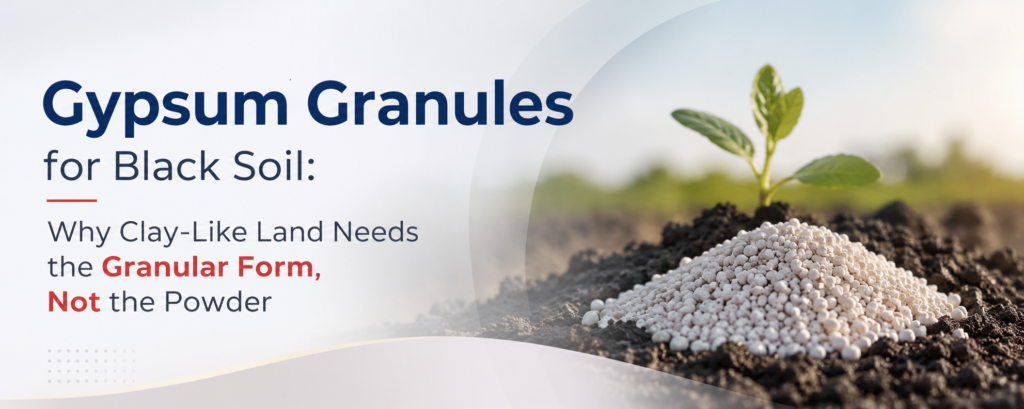
If your field turns into a slab of cracked earth in summer and a waterlogged mess after the first good rain, that’s not bad luck — that’s classic black soil (clay-like soil) behaviour, and gypsum granules are one of the few inputs that actually change the soil structure instead of just feeding the crop for one season.
Most farmers have heard of gypsum. Fewer know why the granular form specifically matters on heavy clay, or why spreading loose gypsum powder for agriculture on a black soil field often disappoints compared to granulated gypsum. Here’s the practical version.
Why Black Soil (Clay-Like Soil) Behaves Differently in the First Place
Black cotton soil — common across large parts of Maharashtra, Madhya Pradesh, and pockets of Rajasthan and Gujarat — is high in expanding clay minerals. That’s the root of the problem. When the soil is clay-like, the particles swell when wet and shrink hard when dry, which is exactly why you get those deep cracks in April-May and standing water in July-August on the same plot.
This swelling-shrinking cycle does two damaging things: it compacts the root zone over time, and it pushes out the calcium that would otherwise help clay particles clump into stable crumbs instead of a dense, airless mass. Once that structure collapses, water stops infiltrating properly, roots can’t push through, and yield drops even with good fertilizer inputs — because the fertilizer isn’t the bottleneck anymore, the soil physics is.
Gypsum Granules vs. Gypsum Powder for Agriculture — Why Form Matters on Clay
This is the part most input dealers don’t explain clearly. Calcium sulphate is calcium sulphate whether it’s powder or granular — the chemistry is identical. What’s different is how each form behaves once it hits heavy clay soil.
- Gypsum powder for agriculture dissolves fast and works well on lighter, sandy-loam soils where quick nutrient release is useful. On black soil, though, powder tends to cake on the surface during application, blow off in wind, or get washed into low spots by the first irrigation before it’s had time to work into the profile.
- Granular gypsum (granulated gypsum) is compressed into a denser particle that spreads evenly, resists wind drift, and — critically for clay soils — breaks down gradually as it absorbs moisture. That slower release is actually the advantage on black soil: it keeps releasing calcium into the root zone over months instead of one quick pulse that clay soil can’t fully absorb before it leaches or runs off.
So the practical rule: gypsum granular form for heavy, clay-like, black soil; powder form is fine for lighter soils where you want faster action and don’t have a wind-drift or runoff problem to manage.
What Granulated Gypsum Actually Does to Clay Structure
Three things happen when granular gypsum breaks down in clay soil, and all three matter more on black soil than on any other soil type:
- Calcium replaces sodium on clay particle surfaces. This is called flocculation — it makes fine clay particles bind into larger, stable crumbs instead of a tight, structureless mass, which is what improves both drainage and aeration.
- Sulphur becomes available for protein and chlorophyll synthesis, which black soil is frequently deficient in despite looking dark and “rich” — the colour comes from organic carbon content, not nutrient sufficiency.
- Infiltration rate improves over successive seasons, not instantly. This is the point that trips up first-time users: gypsum on clay is a structural investment, not a one-season fertilizer swap. Expect the visible difference — better root spread, less surface crusting, water soaking in instead of pooling — to build over 2-3 crop cycles, not the first irrigation.
Recommended Application Rates for Clay / Black Soil
| Crop Type | Dosage (kg/acre) | Notes for Black Soil |
|---|---|---|
| Cereals & Pulses | 100–150 | Apply before land preparation, work into top 5-6 inches |
| Vegetables | 150–200 | Split application across the season on heavier plots |
| Fruit Crops | 200–250 | Apply in the basin area, not broadcast across the orchard floor |
| Oilseeds | 100–150 | Water immediately after spreading to begin activation |
On genuinely heavy, waterlogging-prone black soil, staying at the higher end of the range and repeating over two seasons produces a more visible structural change than one large single dose.
Where Farmers Go Wrong With Granular Gypsum on Black Soil
The most common mistake isn’t dosage — it’s timing. Spreading gypsum granules right before a heavy monsoon burst on already-saturated black soil means most of the calcium moves with runoff before it can bind to clay particles. Apply during land preparation, when the soil can actually absorb the release, not as an emergency fix mid-waterlogging.
The second mistake is assuming granular form means “coarser is better.” Overly large or poorly manufactured granules break down too slowly to matter within a single season, while genuinely under-processed material behaves more like dust than a controlled-release granule. Purity and granule consistency matter more than particle size alone — a 98% purity granulated gypsum with uniform granule size outperforms a cheaper, inconsistent batch even at a higher application rate.
Choosing the Right Gypsum Granular Product
Not every product labelled “granular” behaves the same in the field. Look for stated purity (98% is a reasonable benchmark for agricultural-grade material), consistent granule sizing rather than a mixed dust-and-granule bag, and a manufacturer who can tell you the calcium, magnesium, and sulphur composition rather than just “gypsum” on the label. Gypsona’s Black CMS Gypsum Granules are manufactured at 98% purity specifically in granular form for this kind of long-duration soil-conditioning use, with a single application typically lasting through multiple seasons rather than needing a yearly repeat.
FAQs
How do you know if the soil is clay-like and needs gypsum?
If the field cracks deeply when dry, holds standing water after rain instead of draining, and feels sticky or forms a hard crust when wet, that’s typical clay-like (black soil) behaviour — a strong indicator that gypsum’s calcium-for-sodium exchange will help restore soil structure.
Is granular gypsum better than gypsum powder for agriculture on black soil?
For heavy clay soils specifically, yes — granular form resists wind and water loss during application and releases calcium gradually as it breaks down, which suits clay’s slower absorption compared to sandy soils where powder’s fast release is less of a drawback.
How long does one application of gypsum granules last?
On black soil, a properly applied dose of granulated gypsum can continue improving soil structure for up to three years, though the visible yield and drainage benefits typically build gradually across two to three crop cycles rather than appearing immediately.
Can gypsum granules be mixed with fertilizers or micronutrients?
Yes — granules are commonly used as a carrier for humic acid, fulvic acid, seaweed extract, or micronutrient blends, which is one practical advantage of the granular form over loose powder for combined nutrient management programs.