Gypsum Plaster for AAC Block & Fly Ash Brick Wall Plastering
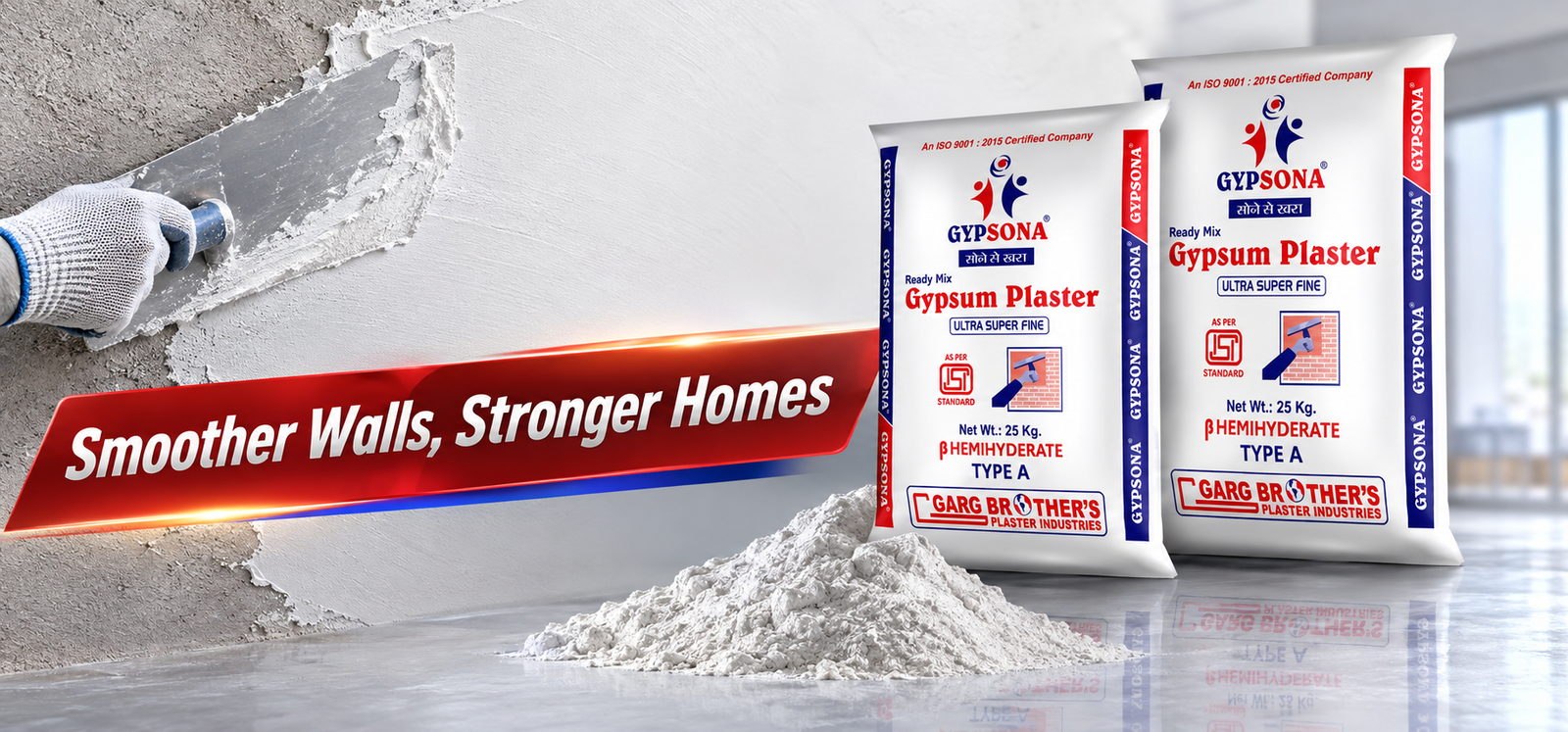
Welcome the world of Innovation and Tradition in Gypsona. We are the leading gypsum plaster manufacturer in Rajasthan with over 25 years experience. It provides the best AAC block wall plastering and gypsum plaster for fly ash brick surfaces.
Our gypsum plaster sets in just 20 minutes, bonds seamlessly with AAC blocks and fly ash bricks, and offers fire, moisture, and thermal resistance. Trusted by builders across India for its lightweight strength and flawless finish, Gypsona plaster ensures faster, more efficient, and reliable wall plastering. If you are constructing a home, remodeling an area, or planning the beautiful interiors—Gypsona delivers smoothness, strength and sophisticated touch that your walls require.
Why Choose Gypsona Gypsum Plaster?
And this is what makes Gypsona Gypsum Plaster unique:
- Super White Finish: Becomes a clean and aesthetic look to walls and ceilings.
- High Purity (90%): Only the best gypsum that has been refined with carefulness and no silica at all.
- Excellent Adhesion: Bonds easily with the AAC blocks and fly ash bricks.
- No Water Curing Required: Save time, resources, and effort.
Suited for AAC Block Wall Plastering
Plastering AAC blocks using Gypsona provides a smooth, crack free and light surface. Our plaster provides a better bond with AAC (Autoclaved Aerated Concrete) blocks, eliminating problems of de-bonding or shrinking.
Advantages of USE of Gypsum Plaster on AAC Blocks:
The company offers an extensive array of AAC blocks which cover all construction requirements:
| Feature | Gypsona Gypsum Plaster | Traditional Plaster |
|---|---|---|
| Setting Time | 20 mins | 24–48 hrs |
| Water Curing | Not Required | Required |
| Surface Cracking | Minimal to None | Common |
| Weight Load | Lighter on Structure | Heavier |
| Finish Quality | Smooth & Uniform | Uneven |
Perfect for Gypsum Plaster on Fly Ash Brick Walls
Fly ash bricks are widely used in modern construction. However, plastering them requires a material that can adapt to their slightly porous texture.
Why Gypsona is Perfect:
- Forms a strong, lasting bond with fly ash surfaces.
- Provides a ready-to-paint finish with minimal prep.
- Adds thermal insulation, ideal for all-weather applications.
Application Steps — Simple & Effective
Follow these easy steps for a flawless finish every time:
Mixing Ratio: Add Gypsona plaster to water (not the other way). Use a 70% water-to-plaster ratio.
Apply Smoothly: Spread evenly on AAC blocks or fly ash bricks using a trowel.
Recommended Thickness: Maintain a 10–15 mm layer.
Final Touch: Trowel to perfection and let it dry thoroughly before painting.
Eco-Friendly & Efficient
Gypsona plaster not only beautifies your walls but also cares for the environment:
Technical Superiority You Can Trust
Here's what makes Gypsona a technical marvel:
- Purity: Over 90% CaSO4.½H2O
- Whiteness: Over 80 lumens
- Flexural Strength: Up to 3 N/mm²
- Compressive Strength: 9 N/mm²
- Final Setting Time: 20 minutes
- Fineness: 100% pass through 425-micron sieve
Storage & Shelf Life
Storage Guidelines
- Shelf life: 3 months (sealed)
- Use within 7 days of opening
- Store in a dry, moisture-free environment
Example
Gypsum Plaster: Frequently Asked Questions
Does gypsum plaster need water curing?
No. Gypsum plaster gains strength as it dries and does not need water curing like cement plaster. This saves water and about two to three weeks of curing time, so painting can start once the wall is dry, usually within a few days.
Can gypsum plaster be applied directly on AAC blocks?
Yes. Gypsum plaster bonds well to AAC blocks and fly ash bricks. Clean dust, wet the surface lightly, fix corner beads and apply a single coat of about 10-15 mm, then level and finish. It is meant for internal walls only.
What thickness of gypsum plaster is used?
A typical internal coat is 10-15 mm on AAC blocks and fly ash bricks, and up to about 20 mm in places on uneven brick walls. Very thick layers should be built in two coats.
Is gypsum plaster good for exterior walls?
No. Gypsum plaster is for internal walls and ceilings. It softens with long exposure to rain and moisture, so exterior walls and wet areas like bathrooms should use cement-based plaster.
Which is better, gypsum plaster or cement plaster?
For internal walls, gypsum plaster is faster, needs no curing, shrinks less and gives a smooth, paint-ready finish. Cement plaster is better for exteriors and wet areas. Many builders now use gypsum inside and cement outside.
Let's Build Something Beautiful
Ready to transform your walls? Choose Gypsona—the trusted name in gypsum plaster on AAC blocks and fly ash bricks. Smooth, reliable, and future-ready.
Contact us today to place your order or get a free consultation with our plastering experts.