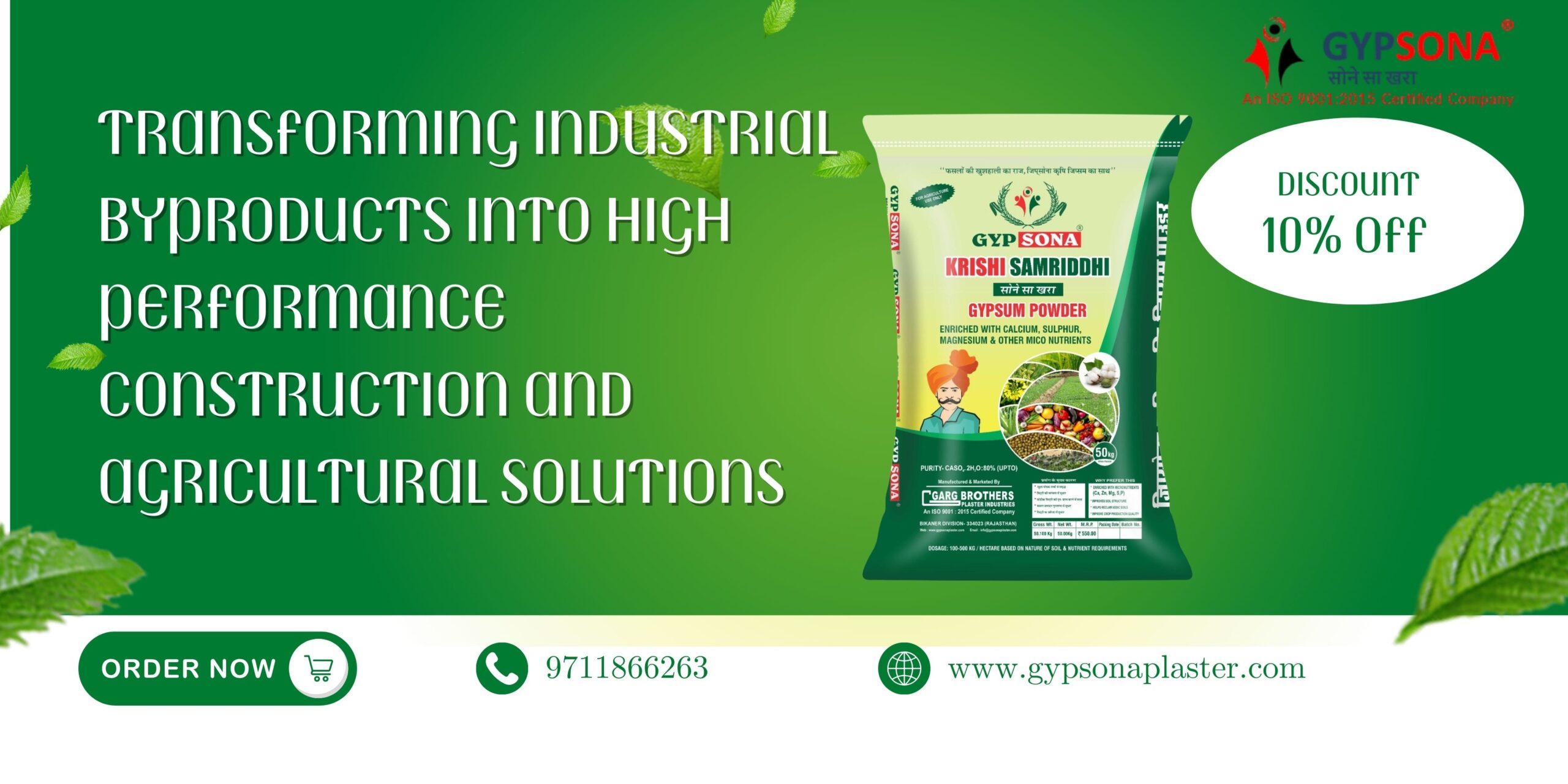
21 Dec Transforming Industrial Byproducts into High-Performance Construction and Agricultural Solutions
Synthetic Gypsum
Why Gypsona Plaster Leads in Synthetic Gypsum Supply
It is difficult to find reliable synthetic gypsum suppliers that not only maintain material quality but also understand the application requirements in the construction and agricultural markets of today. Gypsona Plaster has become a reliable partner by providing a chemically pure synthetic gypsum that has the same performance as natural gypsum and at the same time supports environmental sustainability. Our synthetic gypsum is very instrumental in the production of cement, plasterboard, soil amendment, and industrial applications while at the same time providing the consistent quality that meets the technical specifications of a high standard.
We understand that manufacturers, contractors, and agricultural professionals need more than just the delivery of materials. You need suppliers that will give you technical documentation, application guidance, and a supply chain that is always available so that your operations can continue running without any interruption. Gypsona Plaster is strategically combining sourcing from certified FGD (Flue Gas Desulfurization) facilities and strict quality testing to make sure that every shipment is in accordance with your exact requirements. In case you are manufacturing gypsum boards, producing cement retarders, or using agricultural soils for your crops, then our synthetic gypsum is the one that will give you the performance you can trust.
Understanding Synthetic Gypsum: Composition and Advantages
Synthetic gypsum, or FGD gypsum or chemical gypsum, is calcium sulfate dihydrate (CaSO₄·2H₂O) that is created from a byproduct of an industrial process, mainly the flue gas desulfurization systems of power plants. The chemical reaction between coal-fired power plants absorbing sulfur dioxide with a limestone slurry will generate synthetic gypsum, and the purity of the synthetic gypsum is often above 95%. This material is the same as natural gypsum from the earth.
The benefits of synthetic gypsum to the environment are large. By using the industrial waste that is left over, the need for natural gypsum to be mined is less as well as the need for landfills to be filled up with waste. Power plants have turned the idea of FGD gypsum to a valuable resource instead of waste, hence, this is creating a circular economy that is compatible with the sustainability global goals. In fact, due to the uniformity in its chemical composition, synthetic gypsum can be more advantageous than natural deposits that might contain different types of impurities affecting performance.
As a matter of fact, synthetic gypsum is just like natural gypsum in terms of its practical uses. The cement industry employs it as a setting retarder, thus, the hydration rates are under the control so as to get the working times that are the best. The gypsum board producers get very consistent particle size and purity which results in the uniformity of the board properties. Farmers get the great benefits of providing calcium and sulfur nutrients besides soil improvement in heavily-clayed or sodium-affected soils. The substance’s water solubility makes sure that the nutrients become plant-available at a fairly quick rate after the application.
Our Quality Standards and Supply Chain Excellence
Gypsona Plaster’s synthetic gypsum procurement starts with partnerships with certified FGD facilities that keep their production parameters stable. We do complete supplier audits to confirm the verification of process controls, quality management systems, and environmental compliance. Only the plants that meet our strict standards become the part of our supply network, thus providing the material uniformity from all shipments.
Quality checks are performed at a few points. The samples taken from FGD facilities undergo laboratory tests for calcium sulfate content, moisture, pH, particle size distribution, and impurity screening. We also analyze metal pollutants, chlorides, and other contaminants that may limit the end-use applications. Our standard is in line with ASTM C22, which stipulates the quality criteria for gypsum and related products, with further testing requirements for, e.g., agricultural use, where nutrient content is essential.
Gypsona Plaster’s logistics capabilities are the reason why they are ahead of other competitors in the market. We have strategic stockpiles near major consumption centers and thus we can assure short delivery times even for big orders. Our vehicles consist of covered trucks for bagged material and specially built trailers for bulk pneumatic delivery, which means we can meet your requirements whether you have the loading facility. Continuous supply is guaranteed for industrial users by vendor-managed inventory programs, which we set up with you and which automatically signal orders based on your consumption.
Customer Success Across Industries
Vijay Malhotra, Production Manager at a major cement plant, reveals: “Gypsona Plaster’s synthetic gypsum has been our choice for the past three years, and we have not thought of changing it since then. The uniformity in the chemical composition is the reason that we hardly have to adjust the parameters of our clinker grinding. Their technical team gave us the correct dosage when, cement setting characteristics were actually by us, for a 12% cost reduction. ”
Agricultural Consultant Priya Joshi, Soil Health Expert, says: “I advise solutions with Gypsona synthetic gypsum to farmers suffering from sodic soils in Punjab and Haryana. The product is ideal for the reclamation process, and the sulfur content is the one that solves the deficiency that we frequently encounter in wheat and rice crops. Farmers are very comfortable with the product price compared to the imports, and I am very sure of the quality consistency.”
Competitive Pricing and Flexible Supply Terms
Transparent pricing is the feature that really defines our relationships with customers. Gypsona Plaster pricing is quite competitive and depends on the volume of the order, the delivery location, and the duration of the contract, while the detailed quotations that we provide include all the costs upfront. We reward the pricing of long-term supply contracts with lower prices as a reflection of our commitment to partnership rather than transactional relationships. Our purchasing team keeps an eye on the market situation to make sure that the prices stay reasonable and that the quality standards you are used to are maintained.
We are able to meet the different packaging and delivery requirements of our customers. The bagged synthetic gypsum is packed in 50kg moisture-resistant bags that are suitable for delivery to the construction site or for sales at the agricultural retail. Industrial facilities with pneumatic unloading systems can be served with the bulk shipments of gypsum that are transported in covered trucks or rail cars. Delivery planning can be adjusted to your work schedule if you need shipments on a weekly basis for a continuous production or if you want to receive your bulk deliveries only during the season from agricultural distribution networks.
Frequently Asked Questions
How does synthetic gypsum compare to natural gypsum in performance?
Synthetic gypsum and natural gypsum are, in fact, chemically the same calcium sulfate dihydrate. Their performance characteristics are also the same in any major application. Actually, synthetic gypsum can be of a higher purity and have a more uniform particle size than natural gypsum which in turn can be a source of performance advantages in highly precise applications like plasterboard manufacturing.
Is synthetic gypsum safe for agricultural use?
Surely, synthetic gypsum resulting from FGD operations is an entirely safe material for use in agriculture if it comes from a trustworthy source. Besides not releasing any harmful contaminants, it offers calcium and sulfur which are two of the essential nutrients for plants. Long-term scientific research and then continuous usage in agriculture have been the means of confirming the safety and the beneficial effect of artificial gypsum as a soil improver and a source of crop nutrition.
What documentation do you provide with shipments?
Each shipment is accompanied by certificates of analysis that are specific to the batch and lay out the chemical composition, moisture content, and quality parameters in detail. In the case of agricultural products, we issue more papers giving details of the nutrient content and the setting of application. Industrial customers are issued technical data sheets that contain specifications relevant to their particular use.
Partner With Gypsona Plaster for Quality Synthetic Gypsum
Your operations require suppliers who not only provide top quality materials but also excel in logistics and offer technical support. Gypsona Plaster is your best source of high-quality controlled synthetic gypsum, produced in an environmentally friendly way, and accompanied by customer service far beyond the delivery. If you are making construction products, producing cement, or enhancing agricultural soils, we have the means to assist you in achieving your success.
Reach out to our sales team whenever it is convenient for you to talk over your synthetic gypsum needs. We will deliver technical specifications, offer prices, and supply solutions that suit your operational needs. Partnering with industry leaders, lead to the reliability you can trust.
Call : (9711866263)
Email : (gangeyapandit@gmail.com)
Visit : (https://www.gypsonaplaster.com/)
No Comments