17 Dec Delivering High-Purity Calcium Hydroxide for Construction, Industrial, and Agricultural Excellence
Hydrated Lime Manufacturers
Why Gypsona Plaster Sets the Standard in Hydrated Lime Manufacturing
If your work requires top-notch quality calcium hydroxide, the manufacturer you select is what makes all the difference between getting great results or making costly compromises. Gypsona Plaster has been a leader among lime manufacturers by its commitment to one thing only – purity, consistency, and giving of technical support. Our hydrated lime is a reliable performance that meets high industry standards as it makes from construction plastering and soil stabilization to water treatment and steel manufacturing.
We know that professionals in the construction, agriculture, and industrial sectors need suppliers who offer more than just the material. You need partners who understand the requirements of the application and provide the technical guidance to achieve the best results. This is the reason why Gypsona Plaster, besides advanced manufacturing processes, also provides complete customer support so that you get not only high-quality hydrated lime but also the know-how for its effective use. Our production plants take advantage of premium-grade limestone and very accurate hydration controls to manufacture calcium hydroxide with purity greater than 90% thus granting the product meets the standards of the most demanding applications.
Understanding Hydrated Lime: Properties and Applications
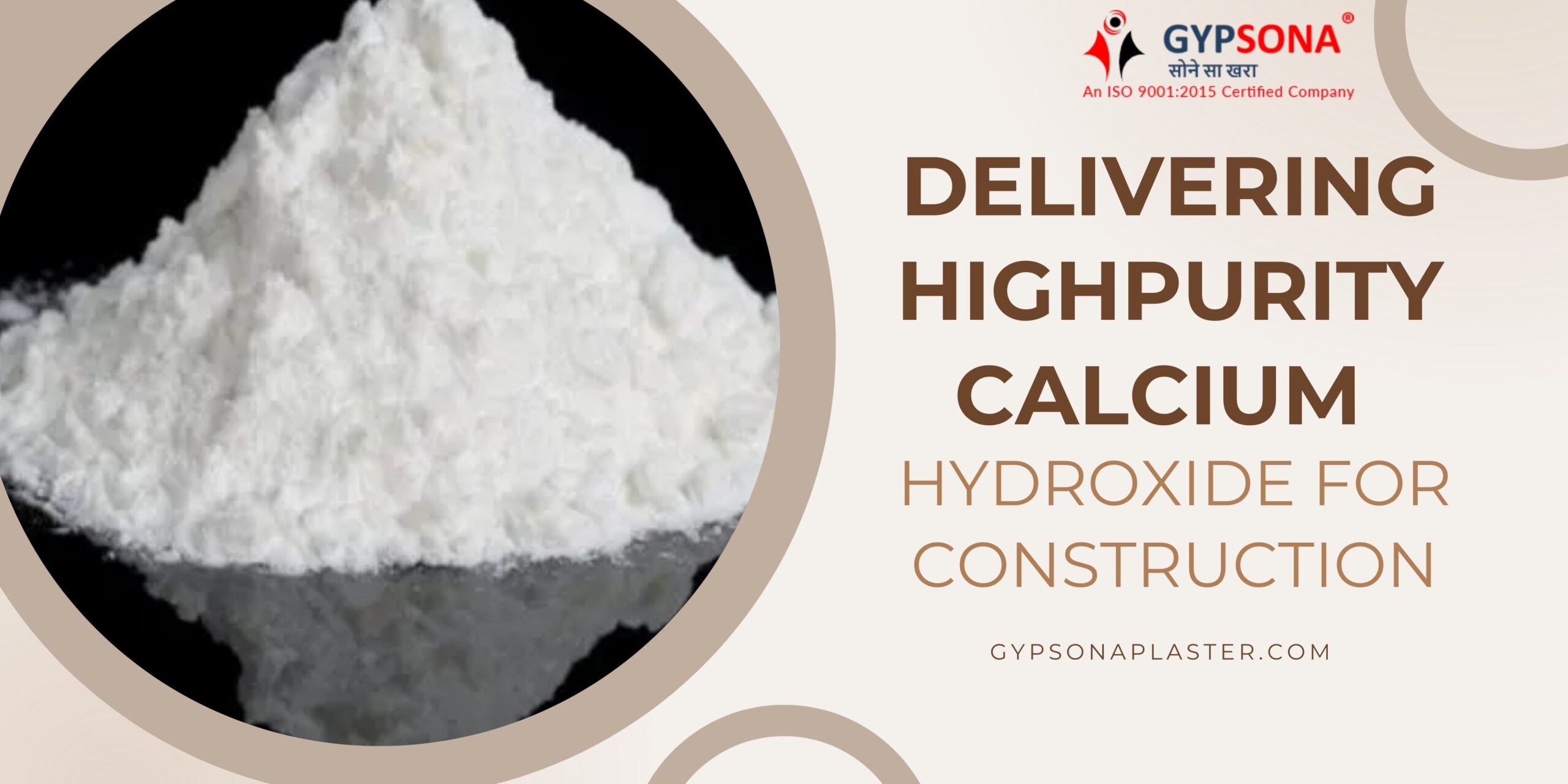
Hydrated lime or calcium hydroxide (Ca(OH)₂) is a chemical implemented in a process called controlled hydration of quicklime (calcium oxide), which results in the white powder known as hydrated lime. Its alkaline character, small particle size, and great binding ability, make this material a source of solutions to problems encountered in such areas, as mortars and environmental remediation.
By applying those power preparing mixture with cement and sand, a mason can achieve, with a smooth finishing, his work more easily and quickly. The material contributes to the retention of water in the cement thus the drying that can weaken the bond is avoided. In addition, hydrated lime is the source of self-healing properties in lime-based plasters, that is when tiny cracks are naturally sealed over time by carbonation.
Moreover, the use of hydrated lime is not limited to the construction sphere but the industrial and agricultural sectors as well. It is a useful agent in steel-making for the removal of slag and the adjustment of pH. Water treatment processes include the softening of hard water and the neutralization of acid effluents is carried out by this agent. The agricultural applications involve the change of soil pH to raise conditions for growing different types of plants. Environmental engineers utilize hydrated lime in aerosol pollution control systems, where it is engaged in the capture of sulfur dioxide emissions. Thus, making it a very important piece of the industry of the 21st century.
Our Manufacturing Process and Quality Assurance
Gypsona Plaster’s leading-edge manufacturing process starts with the selection of top-notch limestone from environmentally friendly and reliable quarries. Our choice of raw materials is based on the content of calcium carbonate, which is more than 95%, thus ensuring the purest base for the production of hydrated lime. The limestone is heated in the state-of-the-art rotary kilns with the temperature being adjusted and controlled very accurately, so as to obtain quicklime with the least possible impurities from the conversion of calcium carbonate to oxides.
It is at the hydration stage that the manufacturing skill is highly evident. Our plants have the use of advanced hydration chambers where quicklime is reacted with water under very precise and controlled conditions. The controlling of the temperature, the water-to-quicklime ratio, and the time the mixture is left to react are all factors that are taken into account so as to obtain hydrated lime with a particle size distribution that is uniform and the hydration will be complete. If the hydration is incomplete, the material used will be unstable, and problems will arise in the derived applications; that is why our quality checks involve a wide range of tests at this vital stage.
They carry out detailed lab analyses on every production batch. Testing for calcium hydroxide content, residual quicklime, particle fineness, specific gravity, and plasticity indices are also done. Our quality assurance measures conform to the Indian Standards IS 712:1984 for building lime specifications. Along with the delivery of batches, the test certificates for such batches are given as a support for quality management systems providing full traceability and documentation. The tough approach taken here ensures that Gypsona Plaster’s hydrated lime is always up to the standard and, in fact, it may even go beyond the specification, no matter what the requirements of the application are.
Client Success Stories
Ramesh Kulkarni, a Civil Contractor with 20 years of experience, shares: “During my career, I have tried different brands of hydrated lime, but it was Gypsona Plaster’s product that really changed our plastering operations. The mortar workability got so much better that we were able to reduce labor time by about 25%. Our clients are always the ones to say it most – the finish is smooth and strong. Also, the technical team helped us by giving different mix ratios for various applications.”
Anita Deshmukh, Ph.D., Environmental Engineer, affirms: “We utilize Gypsona’s hydrated lime in our wastewater treatment plant for pH adjustment and heavy metal precipitation. The stable quality allows us to keep the dosing parameters very exact without the need for constant recalibration. Their technical support led us to the optimization of the treatment process, which in turn resulted in better effluent quality and lower chemical costs.”
Competitive Pricing and Reliable Supply
At Gypsona Plaster, our pricing strategy is influenced by one main factor: transparency. Based on the volume of the order, packaging requirements, and delivery locations, we provide competitive rates along with the detailed quotations, which exclude the hidden costs. Customers, who purchase regularly, enjoy the advantages of quantity discounts and the flexible payment terms, which provide them with support in building a long-term partnership. The members of our sales team are in close contact with the procurement departments in order to create the agreements, which correspond to your operational requirements and budget constraints.
We are committed to providing you with a reliable supply of the product through our logistics. To be able to serve quick even in case of urgent requests, we have a considerable stock of products in warehouses, which are strategically located. Our packaging can be 25 kg bags, 50 kg bags, or bulk shipments through tankers for high-volume industrial users. The product is safe from any quality loss due to storage or transport in moisture-resistant packaging. If your project requires scheduled deliveries, then we will be coordinating the logistics as per your consumption pattern so that you can have a minimum of storage and there will be no supply interruptions.
Frequently Asked Questions
What’s the difference between hydrated lime and quicklime?
Quicklime (calcium oxide) is basically quicklime made from the calcination of limestone, very reactive with water. Hydrated lime (calcium hydroxide) is obtained by adding water in a controlled manner to quicklime, resulting in a stable powder that is safer to handle and easier to use in most applications. Hydrated lime has improved workability in building mortars and more performance that is easily predictable.
How to store hydrated lime?
Keep hydrated lime in a dry place, covered and protected from the moisture. Intact bags should be piled up on pallets which are off the ground. After opening, use the material as soon as possible or close the packaging tightly again. Hydrated lime of good storage keeps its quality for 12 months or even longer. Do not allow direct contact of the material with water until it is going to be used.
Is there any benefit of using hydrated lime in agriculture for soil improvement?
Certainly, hydrated lime is an effective soil pH increaser for acidic soils, thus nutrient availability for the plants becomes better. It also supplies calcium which is absolutely necessary for the development of the plant cell wall. The application of agriculture depends on the current pH of the soil and target pH. We advise doing soil tests prior to application and we can offer technical support for correct dosing.
Partner With Gypsona Plaster for Superior Hydrated Lime
Your projects require products that come from a reliable manufacturer with a lot of technical knowledge. Gypsona Plaster is the answer with its premium quality of hydrated lime which is always of the same quality, has a good price, and offers support that goes far beyond the sale. If you are making construction mortars, treating industrial water, or stabilizing soils, then we are the right team to help you achieve the best results.
Why not get in touch with our technical sales specialists if you need a customized solution that fits your application? Get product specifications, pricing quotations, and delivery schedules that are suitable for your operational requirements. Quality and reliability: two words that remind you constantly of the Gypsona brand.
Call : (9711866263)
Email : (gangeyapandit@gmail.com)
Visit : (https://www.gypsonaplaster.com/)
No Comments